


Ever wondered why some faces instantly read as masculine while others appear feminine? It’s not just about makeup or hairstyle—the differences run deeper, rooted in bone structure, soft tissue distribution, and hormonal influences that shape our faces from birth.
Understanding masculine vs feminine facial features helps you recognize what makes each face unique, whether you’re curious about your own appearance, exploring gender expression, or considering cosmetic adjustments. According to research from the Max Planck Institute for Empirical Aesthetics (2025), female faces consistently receive higher attractiveness ratings across 50 countries, but the story goes far beyond simple beauty standards.
This guide breaks down the key differences between masculine and feminine faces, feature by feature, and shows you how to assess your own facial characteristics.
You’ll discover the science behind why we perceive faces as masculine or feminine, learn practical ways to enhance or soften features, and get answers to the most common questions about facial gender perception. Whether you’re exploring your identity, considering facial feminization surgery (FFS), or simply fascinated by human biology, you’re in the right place.
What Are the Key Differences Between a Masculine and Feminine Facial Features?
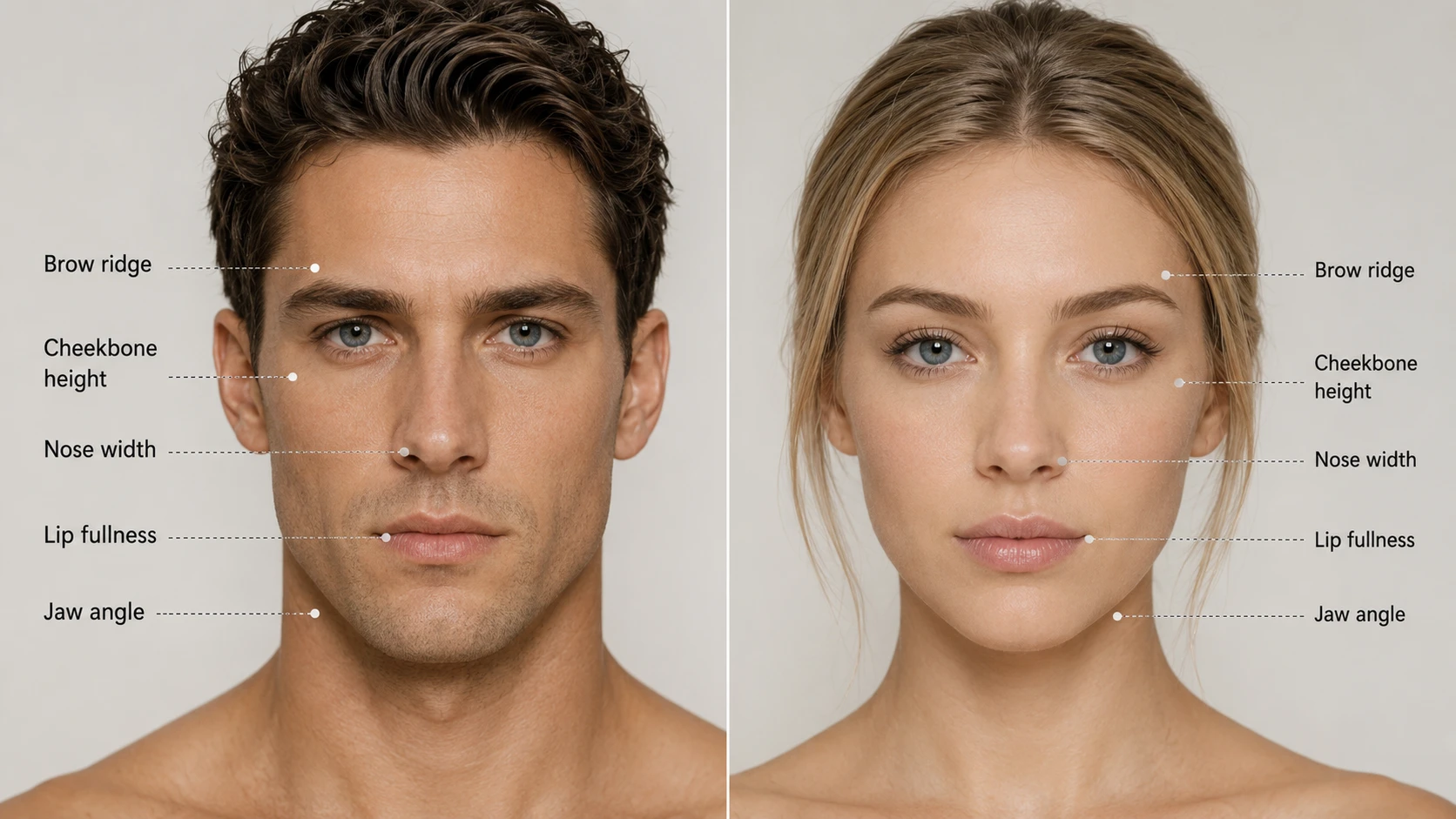
Masculine faces typically feature stronger bone structure with prominent brows, wider jaws, and angular contours, while feminine faces showcase softer curves, fuller cheeks, and delicate features. These differences stem from testosterone and estrogen levels during puberty, which shape facial bones and soft tissues differently in males and females.
Let’s break down each facial feature to understand exactly what distinguishes masculine from feminine faces:
Forehead & Brow Ridge: The First Sign of a Masculine or Feminine Face
The forehead is one of the most telling features when distinguishing masculine from feminine faces. Male foreheads tend to be wider, taller, and slope backward more dramatically. The brow ridge—that bony prominence above the eyes—is significantly more pronounced in masculine faces, creating a shadowed, angular appearance.

In contrast, feminine foreheads are rounder, smoother, and more vertical with minimal to no brow ridge protrusion. The transition from forehead to nose is gentler in feminine faces, creating a softer profile.
Eyes & Eyebrows: How They Differ in Male vs Female Faces
Eye shape and eyebrow position play crucial roles in facial gender perception. Masculine eyes tend to be smaller, more deep-set, and positioned closer to the eyebrows. The eyebrows themselves sit lower on the face, are thicker, and follow a straighter line with less arch. Feminine eyes appear larger and more open, with eyebrows positioned higher above the eye socket.
Feminine eyebrows typically feature a graceful arch, especially at the outer third, and are thinner overall. The distance between the eye and eyebrow is noticeably greater in feminine faces, contributing to that wide-eyed, expressive look.
Nose Shape: A Key Masculine vs Feminine Facial Feature
Nose structure varies significantly between masculine and feminine faces. Masculine noses are generally larger overall, with a wider bridge, more prominent nasal tip, and larger nostrils. The angle between the nose and upper lip (nasolabial angle) is typically around 90 degrees in masculine faces. Feminine noses are smaller and more delicate, with a narrower bridge, refined tip, and smaller nostrils. The nasolabial angle is more acute—usually between 100-110 degrees—creating a slightly upturned appearance that’s considered classically feminine.
Cheeks & Cheekbones: What Sets Masculine and Feminine Faces Apart
Cheek structure dramatically affects how masculine or feminine a face appears. Masculine faces have flatter cheeks with less soft tissue fullness, and cheekbones that are wider and positioned lower on the face. The overall effect is angular and defined. Feminine faces feature fuller, rounder cheeks with more soft tissue volume, especially in the midface area. Cheekbones are high and prominent but create curves rather than angles. This fullness extends from the cheekbones down to the jawline, creating that coveted heart-shaped or oval face contour.
Jawline & Chin: The Most Telling Masculine Face Shape Indicator
The jawline is perhaps the most distinctive feature separating masculine from feminine faces. Masculine jaws are wider, creating a square or rectangular face shape. The jaw angle (gonial angle) is close to 90 degrees, producing sharp, defined corners. The chin is broader, more square, and projects forward prominently. Feminine jaws are narrower and taper to a point, creating a V-line or soft curve. The jaw angle is more obtuse (around 120-130 degrees), producing a gentler transition from jaw to neck. Feminine chins are smaller, more pointed or rounded, and less projecting.

Lips: How Feminine Features Differ from Masculine Ones
Lip fullness is a key indicator of facial femininity. Masculine lips are thinner overall, with less definition between the upper and lower lip. The cupid’s bow (the double curve of the upper lip) is less pronounced or nearly flat. The distance between the nose and upper lip (philtrum) is longer in masculine faces. Feminine lips are fuller and more voluminous, with a well-defined cupid’s bow that creates an attractive curve. The philtrum is shorter, and there’s often more color contrast between the lips and surrounding skin.
Overall Face Shape: Masculine vs Feminine Face Shapes at a Glance
When you step back and look at the whole face, masculine face shapes tend toward squares, rectangles, and diamonds—all characterized by strong angles and straight lines. The face is longer vertically and wider at the jaw. Feminine face shapes lean toward ovals, hearts, and rounds—shapes defined by curves and soft transitions. The face is often wider at the cheekbones and narrows gracefully toward the chin.
However, it’s worth noting that many people have hybrid features that don’t fit neatly into one category, and that’s completely normal.
How to Tell If Your Face Has Masculine or Feminine Features (Self-Assessment)
To determine if your face leans masculine or feminine, compare your features against typical characteristics for each category, focusing on forehead slope, jaw width, cheekbone prominence, and lip fullness. Most faces fall somewhere on a spectrum rather than at either extreme.

Visual Checklist: Compare Your Features
Use this comparison table to assess where your features fall:
| Facial Feature | Masculine Characteristics | Feminine Characteristics |
|---|---|---|
| Forehead | Wider, taller, slopes back, prominent brow ridge | Rounder, smoother, more vertical, minimal brow ridge |
| Eyebrows | Lower, thicker, straighter | Higher, thinner, arched |
| Eyes | Smaller, deep-set, closer to brows | Larger, more open, farther from brows |
| Nose | Larger, wider bridge, 90° nasolabial angle | Smaller, narrower, 100–110° nasolabial angle |
| Cheeks | Flatter, less fullness, lower cheekbones | Fuller, rounder, high prominent cheekbones |
| Jaw | Wider, square, 90° jaw angle | Narrower, tapered, 120–130° jaw angle |
| Chin | Broader, square, projects forward | Smaller, pointed/rounded, less projection |
| Lips | Thinner, flat cupid’s bow, longer philtrum | Fuller, defined cupid’s bow, shorter philtrum |
To use this checklist, stand in front of a mirror with good lighting and examine each feature. Mark whether yours aligns more with masculine or feminine characteristics. Don’t worry if you have a mix—most people do! For example, you might have a feminine nose but a more masculine jawline. These combinations create your unique appearance.
Understanding Your Results
If most of your features align with one category, your face likely reads as predominantly masculine or feminine. However, having 3-5 features from each category is extremely common and doesn’t make your face any less attractive or valid. In fact, research from Penn State University (2025) found that attractive men expressed stronger preferences for facial femininity in women, but many highly attractive male celebrities have softer, more feminine features themselves.
The key takeaway? Facial gender isn’t binary—it’s a spectrum, and beauty exists across all points on that spectrum.
The Biology Behind Masculine vs Feminine Facial Features
Facial masculinity and femininity result from sex hormones—primarily testosterone and estrogen—that shape bone growth and soft tissue development during puberty and beyond. Understanding this biology helps explain why faces look the way they do.
Evolutionary Biology: Why We Distinguish Gender by Face
During puberty, testosterone causes dramatic changes in male faces: the jaw widens, the brow ridge becomes more prominent, the nose grows larger, and facial bones become denser and more angular. These changes served evolutionary purposes—larger jaws could deliver more powerful bites, and prominent brows protected eyes during physical confrontations. Estrogen, conversely, promotes fat deposition in the cheeks and lips while keeping bones smaller and more delicate. These softer features historically signaled youth and fertility.
The differences aren’t just skin-deep. Testosterone actually increases bone density and size in specific facial areas, particularly the lower third of the face. This is why men’s jaws continue to develop into their early twenties, while women’s facial growth typically completes earlier. The hormone also affects soft tissue distribution—men have less subcutaneous fat in the face, creating that chiseled, defined look, while women retain more facial fat, producing softer contours.
How Masculine and Feminine Faces Are Perceived Differently: Competence, Warmth, and Attractiveness
Here’s where it gets fascinating: facial masculinity and femininity don’t just affect how we’re gendered—they influence how others judge our personality and capabilities. According to a 2025 study published in PMC, masculine faces were rated as significantly more competent than feminine faces, with participants associating them with traits like leadership and intelligence. The same study found that feminine faces received higher ratings for warmth, with a mean rating of 5.51 for warmth traits compared to masculine faces.
Eugen Wassiliwizky, lead researcher at the Max Planck Institute for Empirical Aesthetics, explains: “The results showed that participants saw feminine/masculine faces as more consistent with warmth/competence for both male and female faces“. This means even feminine male faces are perceived as warmer, while masculine female faces are seen as more competent.
Interestingly, the study also revealed gender differences in perception. Female participants matched masculine faces with competence traits significantly more than male participants, with a mean rating of 3.81. An implicit association test showed participants reacted faster to masculine faces paired with competence-related words, indicating an unconscious bias (D score of 0.15).
These perceptions have real-world implications. Research from Charles University found that masculine faces were associated with higher dominance and more social boldness, according to researcher Vera Pivonkova. However, it’s crucial to remember that these are statistical trends and stereotypes—they don’t define any individual’s actual personality or abilities.
How to Enhance Masculine or Feminine Facial Features (Non-Surgical)
Yes, you can modify how masculine or feminine your face appears through both non-surgical techniques like makeup and contouring, and surgical procedures like facial feminization surgery (FFS) or masculinization. The right approach depends on your goals, budget, and how permanent you want the changes to be.
Non-Surgical Ways to Feminize or Masculinize Your Face
If you’re looking to soften masculine features or enhance feminine ones without surgery, several techniques can help:
Contouring and Makeup:
To feminize: Use contouring to narrow the jawline, create the illusion of higher cheekbones, and make the forehead appear smaller. Highlight the center of the face to draw attention to eyes and lips. Fuller lip application with gloss or liner can increase lip volume visually.
To masculinize: Contour to create sharper jaw angles, a more prominent brow ridge, and a stronger chin. Use matte products to reduce shine and create more angular shadows. Keep lip color minimal or use darker shades to reduce fullness.
Eyebrow Shaping: Eyebrows dramatically affect facial gender perception. Feminine brows should be shaped with a high arch, especially at the outer third, and kept thinner overall. Masculine brows should be fuller, straighter, and positioned lower on the face. Professional threading or microblading can create lasting results.
Hairstyle and Facial Hair: Hairstyle can frame your face to emphasize or minimize certain features. Soft, layered styles with volume at the crown can feminize, while shorter, more structured cuts can masculinize. For those who can grow facial hair, a well-groomed beard can dramatically masculinize the lower face by adding width to the jaw and covering a smaller chin.
Facial Exercises: While controversial, some people report success with facial exercises (sometimes called “face yoga”) to tone muscles and potentially alter face shape slightly. For masculinization, jaw exercises like chewing gum or using jaw trainers may strengthen the masseter muscles, creating a wider appearance. For feminization, facial massage and lymphatic drainage may reduce puffiness and create more defined contours.
Masculine vs Feminine Face: Your Questions Answered
How do I tell if my face is more feminine or masculine?
Compare your facial features to typical masculine and feminine characteristics, focusing on jaw width, brow ridge prominence, cheekbone height, and lip fullness. Use the self-assessment checklist in this guide to evaluate each feature individually.
Look at your forehead slope (masculine faces slope back more), jaw shape (square vs. tapered), and cheek fullness (flat vs. round). Take a straight-on photo in good lighting and examine these features objectively. Remember that most faces have a mix of masculine and feminine traits, and that’s completely normal.
What does a feminine face look like?
A feminine face features softer curves, fuller cheeks, high prominent cheekbones, a narrow tapered jaw, smaller nose, and fuller lips with a defined cupid’s bow. The forehead is rounder and more vertical with minimal brow ridge, and eyebrows are positioned higher with a graceful arch. Eyes appear larger and more open, and the overall face shape tends toward oval, heart, or round rather than square or rectangular. The chin is smaller and more pointed or gently rounded.
Which face shape is most masculine?
Square and rectangular face shapes are considered most masculine, characterized by a wide jaw, strong angular jawline, and similar width at forehead and jaw. The square face has a jaw width nearly equal to forehead width with a short face length, creating a boxy appearance. The rectangular face is similar but longer vertically. Both shapes feature a jaw angle close to 90 degrees, producing sharp, defined corners at the jaw. Diamond face shapes can also read as masculine when they have a strong, angular jaw despite narrower forehead and cheekbones. These shapes result from testosterone-driven bone growth during puberty.
What makes a girl’s face look masculine?
A prominent brow ridge, wide square jaw, larger nose, flatter cheeks, and thinner lips can make a woman’s face appear more masculine. Other contributing factors include a longer face length, lower eyebrow position, smaller eyes, and a more projecting chin. These features may result from higher natural testosterone levels, genetics, or simply individual variation in facial structure.
It’s important to note that having masculine features doesn’t make someone less feminine or attractive—many successful models and actresses have stronger, more angular features. Beauty standards are diverse, and masculine features on women can be striking and distinctive.
Can a man have a feminine face?
Yes, many men naturally have softer, more feminine facial features including rounder faces, fuller lips, less prominent brows, and gentler jawlines. This can result from lower testosterone levels, genetics, or ethnic background. Research from Penn State University (2025) found that attractive men often have more feminine features, and studies show that feminine male faces are perceived as warmer and more trustworthy. Many male celebrities and models have softer features that contribute to their appeal. Having a feminine face as a man doesn’t affect masculinity or identity—it’s simply a variation in facial structure that can be very attractive.
Is there a difference between male and female faces?
Yes, biological males and females typically develop different facial structures due to sex hormones, with males having larger, more angular features and females having softer, rounder contours. Males generally have wider jaws, more prominent brow ridges, larger noses, flatter cheeks, and thinner lips. Females typically have narrower jaws, smoother foreheads, smaller noses, fuller cheeks, and more voluminous lips.
How does age change facial gender perception?
Aging affects masculine and feminine faces differently, with both sexes experiencing bone resorption, fat loss, and skin changes that can alter gender perception. Women’s faces may appear more masculine with age as they lose facial fat (especially in cheeks), experience bone loss that widens the lower face, and develop more angular contours. Men’s faces may soften slightly as testosterone levels decline, though they generally retain more masculine structure. Both sexes experience sagging skin that can obscure jawlines and change face shape. These changes typically accelerate after age 40, with the most dramatic facial aging occurring between ages 50-60.
Conclusion
Understanding the differences between masculine and feminine faces goes far beyond simple aesthetics—it’s about recognizing the biological, social, and personal factors that shape how we see ourselves and others. Whether your face leans masculine, feminine, or somewhere beautifully in between, each feature tells a story of hormones, genetics, and individual development.
The key differences we’ve explored—from forehead slope and brow ridge prominence to jaw width and lip fullness—create the visual cues our brains use to instantly categorize faces. But here’s what matters most: these categories are descriptive, not prescriptive. Research shows that masculine faces are perceived as more competent while feminine faces are seen as warmer, but these are stereotypes that don’t define any individual’s actual personality or worth.
If you’re considering changing your facial appearance, you now have a roadmap of both non-surgical and surgical options. Makeup, contouring, and styling can create temporary transformations, while procedures like facial feminization surgery or masculinization offer permanent changes. Whatever path you choose—or if you choose to embrace your natural features exactly as they are—the most important thing is that your face feels authentically yours.
Your facial features are unique, and that uniqueness is what makes you memorable. Whether you have a square jaw with full lips, a delicate chin with thick eyebrows, or any other combination, you’re part of the beautiful diversity of human faces.
References
- Female faces rated higher in attractiveness across 50 countries – Max Planck Institute (2025)
- Masculine faces associated with competence, feminine faces with warmth – PMC (2025)
- Masculine faces, dominance and social boldness – Charles University Research
- Attractive men prefer feminine female faces – Penn State University (2025)