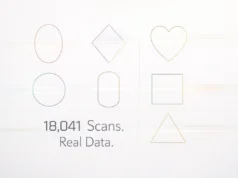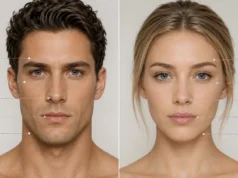
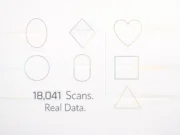
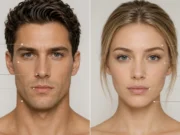
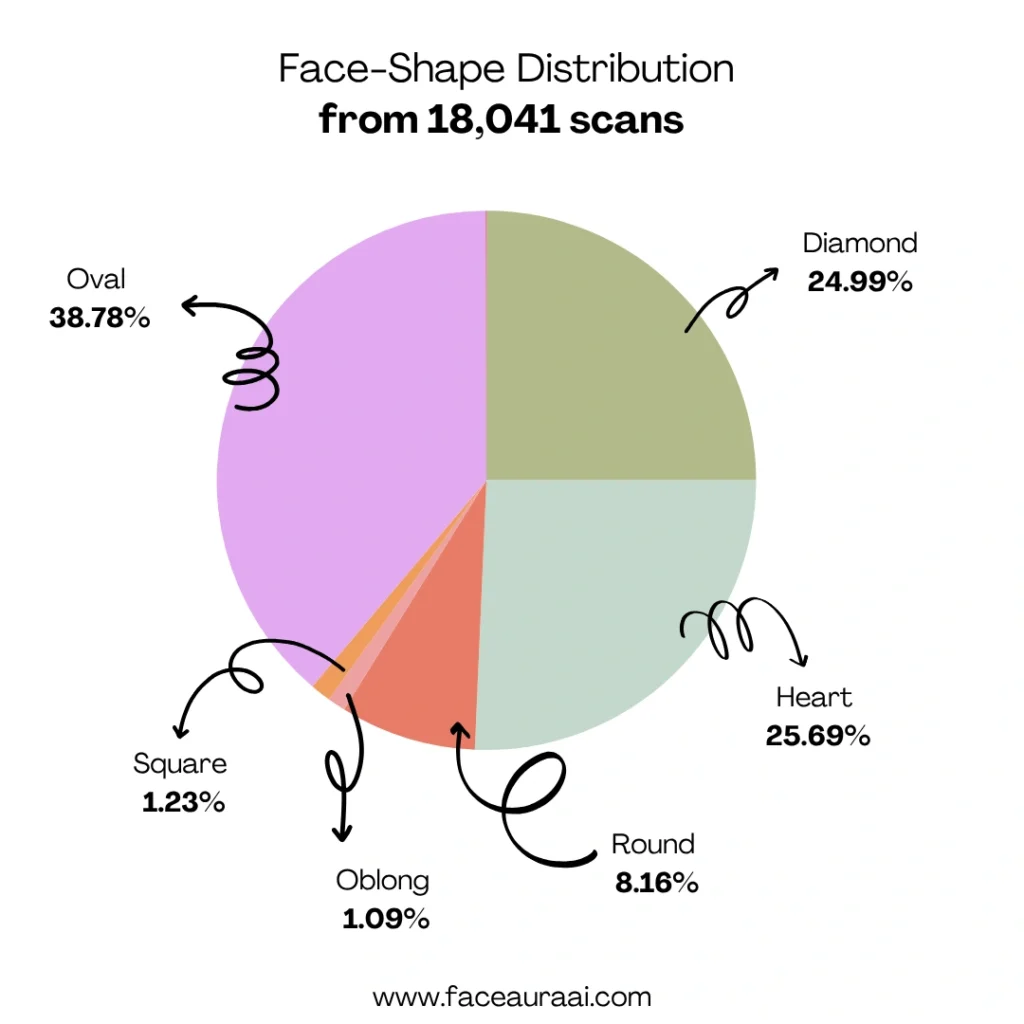
Square jaw. Strong angles. The face shape that sells men’s grooming products, anchors contouring tutorials, and appears in almost every face-shape infographic. Yet across 18,041 real FaceAura AI face-shape scans, a true geometric square face appeared 222 times. That is 1.23% of the full dataset.
Triangle was rarer still: 9 scans out of 18,041, or 0.05%. FaceAura AI’s data does more than show which shapes are common. It shows which face-shape labels beauty media repeatedly highlights despite being structurally uncommon in measured scan results.
What “Rare” Actually Means in a Face Shape Dataset
When a magazine calls a face shape “rare,” they usually mean it looks striking in photographs. When an AI dataset calls a shape rare, it means something more specific: the measured proportions of that face — jawline width, cheekbone width, forehead width, face length ratio — matched that geometric profile in fewer than 1% of cases.
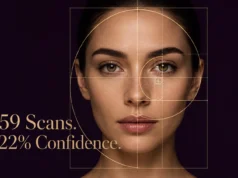
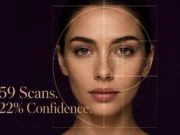
FaceAura AI’s Face Shape Detector maps facial landmarks and runs them through a geometric classification model based on forehead-to-cheekbone width, cheekbone-to-jaw width, face length-to-width, and jaw angle with chin taper. Across the 18,041 eligible anonymized scans in this dataset, the average classification confidence was 93.96%, with a median confidence of 95%..
The difference matters: because it separates cultural rarity from anatomical rarity. A face shape can be rare in the sense that it photographs dramatically (square, for example), while simultaneously being rare in the sense that almost no one structurally has one. In this dataset, both happen to be true for the same shapes — and the gap between perception and reality is wider than most people expect.
The Rarest Face Shapes, Ranked
Triangle – The Rarest of All (0.05%)
Nine results in 18,041 scans. A triangle face is defined by a jawline that is measurably wider than the cheekbones and forehead — the face becomes wider as it moves downward. This is the inverse of the more common heart-shape pattern.
Because triangle represents only 0.05% of this dataset, treat the figure as a strong rarity signal rather than a population prevalence estimate. A small number of additional scans could move the percentage slightly, but the ranking is clear: triangle is the rarest classification in FaceAura AI’s current scan log.
If you have a triangle result, prioritise volume at the crown and temples, and avoid styles that add unnecessary visual width around the jaw. That helps balance the lower third rather than making it appear heavier.
Square – Much Less Common Than Beauty Media Suggests (1.23%)
222 people out of 18,041 scans matched a true geometric square profile. That is 1.23% of the dataset.
A square face requires several conditions at once: forehead, cheekbones, and jawline must be close in width, with a flatter chin and visible angularity through the jaw. A pronounced jaw alone does not make a face square. Many people who self-identify as square are closer to oval, diamond, or heart when their full proportions are measured.
For styling, the goal is not to hide the angles. It is to add movement and avoid making the face read too blocky: textured cuts, soft layers, controlled side volume, and rounded or oval eyewear can all work well depending on hair density and personal style.
Rectangle / Oblong – Uncommon, but Often Misidentified (1.09%)
Rectangle / Oblong appeared in 196 of 18,041 scans, or 1.09% of the dataset. It is slightly more common than a true square profile, but still far below the four largest categories.
A rectangle or oblong face is visibly longer than it is wide, with relatively consistent width through the forehead, cheekbones, and jaw. It is commonly confused with oval because both can look balanced in a quick mirror check. The defining difference is that rectangle/oblong has a more pronounced length-to-width ratio and less taper through the lower face.
The styling objective is to add visual width without adding extra vertical height. For hair, that usually means side movement, texture at cheek or jaw level, and restraint with very tall pompadours or high-volume updos.
Why Most People Think They Have a Rarer Shape Than They Do
Across the full dataset, 97.63% of people who completed an eligible scan have Oval, Heart, Diamond, or Round face shapes. Those four categories account for 17,614 of the 18,041 results.
Yet in informal surveys and beauty community forums, you’ll find a much more even spread of self-reported shapes — more people claiming square, more claiming heart, fewer claiming oval. The gap between self-reported and measured shape isn’t small. It reflects something real about how people perceive their own faces.
There’s a psychological pull toward rarer shapes. A square jaw signals strength. A heart face signals femininity. These are culturally loaded categories, and people naturally gravitate toward the one that feels most flattering to claim. Oval, despite being the most structurally balanced face shape, often gets dismissed as “too plain” to identify with — even when it’s the accurate answer.
This is where measured geometry changes things. It doesn’t have an opinion about which shape you should want. It measures what’s actually there. Getting an accurate result — not a flattering guess — is what leads to styling choices that actually work.
What Having a Rare Face Shape Means for Styling
Rare face shapes are underserved by most styling content. Generic guides won’t cover you — so here’s what actually works for each.
Square (1.23%)
A true square face doesn’t need softening as aggressively as most guides suggest. The angles are a structural asset. The real goal is balance — stopping the face from reading as flat or blocky. Oval and round glasses frames soften the jaw angles without hiding them. For hair, length that sits below the jaw adds vertical movement and prevents the face from reading as a perfect box. Textured, layered cuts work better than blunt ends. See the full breakdown: best hairstyles for square face men and hairstyles for square face shape women.
Rectangle / Oblong (1.09%)
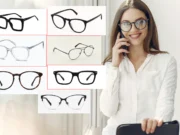
The objective is adding visual width to a face that is longer than it is wide. Wide-frame glasses — particularly browline or rectangular frames with strong horizontal presence — do this well. For hair, the best choices add volume at the sides: waves, curls, or a layered cut with outward movement at the cheeks. Center parts and sleek, flat styles emphasize the vertical length, which is the opposite of what an oblong face benefits from. Avoid very tall updos for the same reason.
Triangle (0.05%)
The styling logic here flips the heart-face playbook. Where a heart face needs weight added at the jaw, a triangle face needs volume at the top to balance a heavier lower third. Cat-eye and browline glasses that widen the appearance of the upper face work well. For hair, volume at the crown — layers, a high bun, styles that build upward — redistributes visual weight away from the jaw. A wide, full fringe can also narrow the forehead-to-jaw contrast by adding horizontal presence at the top.
Find Out If You Have a Rare Face Shape
The reliable way to identify face shape is measurement, not a quick mirror check. FaceAura AI’s Face Shape Detector analyzes facial proportions from one uploaded photo and returns a face-shape result with a confidence score in under 30 seconds.
Rarity does not determine attractiveness. It only tells you how often a measured geometric profile appeared in this self-selected scan dataset. Knowing your actual shape helps you choose styling advice written for your structure rather than someone else’s.
Rarity doesn’t determine attractiveness — the data makes that clear the moment you see how few people actually have the “coveted” shapes. But knowing your actual face shape, rare or common, is the difference between styling advice that was written for someone else and styling choices that were made for you.
Data source: FaceAura AI Face Shape Detector scan log, N=18,041 eligible anonymized scans, 11 November 2025–2 September 2026. Average classification confidence: 93.96%; median confidence: 95%. Facial landmarks detected via Amazon Rekognition and classified using FaceAura AI’s geometric face-shape model. No images or personal data are retained.
Looking for haircut guidance instead of data analysis? Explore men’s hairstyles by face shape or women’s hairstyles by face shape.