

FaceAura AI’s Golden Ratio Calculator has now analyzed 8,016 anonymized facial-proportion scans. The dataset has a 94.19% average confidence score and a 95% median confidence score.
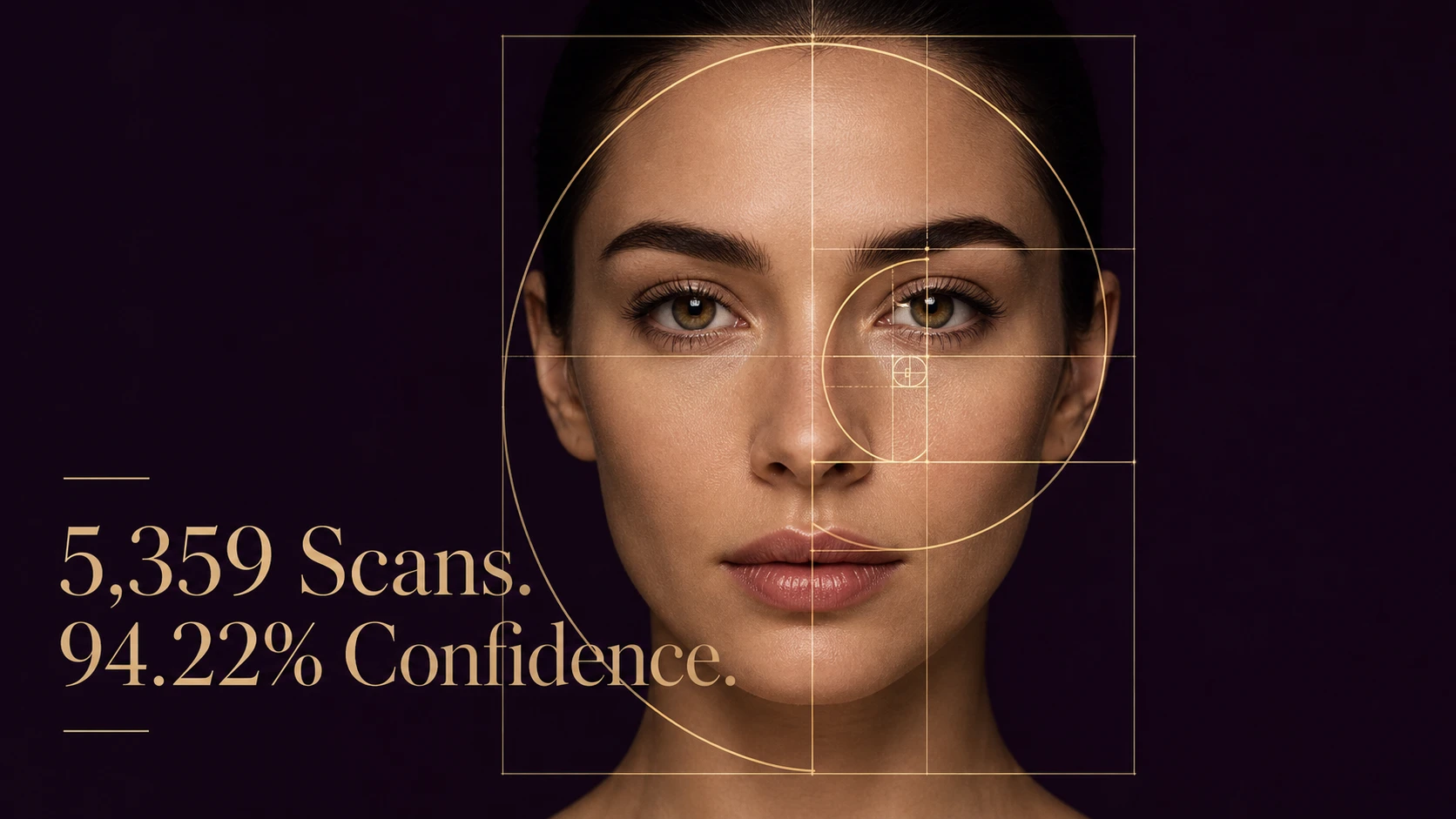
FaceAura AI’s Golden Ratio Calculator has processed 5,359 face scans — the highest volume of any tool in the FaceAura suite — with an average confidence score of 94.22% and a median of 95%. This is the first time that data has been analyzed at scale. What it reveals isn’t a verdict on who is beautiful. It’s a picture of how real human facial proportions relate to a mathematical ideal, across thousands of people who were curious enough to find out.
Golden-ratio analysis measures facial-proportion patterns; it does not classify face shape. For landmark-based face-shape results across 14,114 scans, see our Face Shape Detector study.
Da Vinci’s Formula vs. Modern AI
The golden ratio’s association with facial beauty is often traced to Leonardo da Vinci — his anatomical drawings and portrait work applied proportional systems extensively, referencing ratio relationships between facial features. What da Vinci did by hand with calipers and close observation, modern AI does in under 30 seconds across 100 facial landmarks per image.
But speed is the least interesting part of that shift. Before AI tools, golden ratio analysis of a real face required a trained aesthetic practitioner, measurement instruments, and a clinical appointment. 5,359 people did it from a phone, for free, with no specialist required. That’s not an incremental improvement — it’s a different category of access entirely. The mathematical framework is unchanged since the Renaissance. Who can use it is what’s new.
What the Golden Ratio Actually Measures on a Human Face
Strip away the history and the golden ratio is a geometric statement: a proportion where the ratio of the whole to the larger part equals the ratio of the larger part to the smaller one. That value is approximately 1.618, denoted as phi (φ).
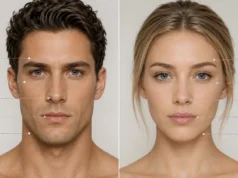
Applied to a human face, FaceAura AI’s calculator measures five specific axes:
- Facial thirds proportion — the face divided horizontally into three zones: hairline to brow, brow to nose base, nose base to chin. In a face that aligns with phi, these thirds are roughly equal in height
- Face width-to-length ratio — a visually balanced face measures approximately 1.618 times longer than it is wide
- Eye distance ratio — the horizontal distance between pupils relative to total face width. Research published in Psychonomic Bulletin & Review found attractiveness peaks when interocular distance is approximately 46% of face width — consistent with phi-adjacent proportions
- Nose width ratio — the width of the nose relative to the distance between the eyes
- Eye-to-mouth vertical ratio — the vertical distance between eyes and mouth as a proportion of total face length, with an optimal value of approximately 36%
The output is a score reflecting how closely the face’s proportions cluster around 1.618 across all five axes — not pass/fail, but a proximity measurement.

Why 5,359 People Used This Tool
The Golden Ratio Calculator is the most-used tool in FaceAura AI’s dataset — more scans than the face shape detector, face symmetry analyzer, or any other tool in the suite. That usage volume is its own signal.
People come to golden ratio analysis from several directions. Some arrive from straightforward beauty curiosity — they’ve seen the ratio referenced in a video and want to know where they land. Some are doing pre-consultation research before cosmetic procedures, using the score as a reference point before a conversation with a surgeon or aesthetic practitioner. And a meaningful number are looking for a form of self-validation: the golden ratio carries cultural authority, and a high score feels like objective confirmation of something they already wanted to believe.
What the scan volume actually reflects is a question people have always had but couldn’t previously answer without specialist access: what is actually going on with my proportions? AI made it answerable.
Confidence Score and What It Tells Us
The Golden Ratio Calculator returned an average confidence score of 94.22%. For context, FaceAura AI’s Face Symmetry Analyzer returns an average of 54.07% — with 58.01% of users scoring in the “developing” symmetry range.
The gap comes down to geometry. Ratio scoring works from vertical and horizontal distances between landmarks, which stay stable across most photo conditions. Symmetry analysis requires precise bilateral comparison of landmark positions across both sides of the face — making it far more sensitive to head angle, lighting, and image quality.
| Tool | Confidence Score (%) |
|---|---|
| Face Symmetry Analyzer | 54.07 |
| Golden Ratio Calculator | 94.22 |
One more number worth noting: only 32.47% of results returned a clean “calculated” phi score. The remaining results reflect cases where landmark detection was strong, but the proportional measurement couldn’t be resolved to a single score — typically due to partial face visibility or specific landmark spacing. That’s not a failure rate. In other words, nearly 1 in 3 users got a clean phi output. The rest got solid landmark data without a resolvable ratio — which itself tells you something about how varied real human proportions are.
What High vs. Low Golden Ratio Scores Actually Mean
A high score means your facial proportions cluster close to 1.618 across multiple measurement axes. A low score means they don’t. Neither is a verdict on attractiveness.
Research published in PNAS and the Journal of Cosmetic Surgery confirms that while proportional harmony contributes to perceived attractiveness, it is one variable among many — skin texture, facial movement, expression, symmetry, and feature distinctiveness all factor in independently. Some of the most recognizable faces in the world score poorly on strict phi-ratio measurement and are considered highly attractive. The reverse is also true.
What the scoring does well is provide a consistent, repeatable geometric reference. If you’ve wondered whether your forehead-to-midface ratio is balanced, or whether your eye spacing reads wide or narrow relative to your face width, a phi-ratio score gives you an objective answer — grounded in the same mathematical framework aesthetic surgeons and facial analysts use as a clinical baseline. That’s a different kind of useful than “you’re beautiful.” It’s specific, measurable, and yours to do something with.
The Relationship Between Golden Ratio and Facial Symmetry
Symmetry and phi-ratio are related but they measure different things — and the data separates them clearly.
Symmetry asks: do the left and right halves of your face mirror each other? Phi-ratio asks: do the distances between your features follow a specific proportion? A face with strong golden ratio proportions — balanced thirds, ideal eye spacing, proportional nose width — may still have meaningful left-right asymmetry. A highly symmetrical face may sit well outside phi thresholds. The 40-point gap between the two tools’ confidence scores reflects exactly this divergence in what each is measuring.
Most human faces carry some degree of asymmetry — research consistently places true bilateral symmetry as rare. What golden ratio scoring captures is a separate quality: whether the overall architecture of the face, regardless of side-to-side balance, follows proportions the human visual system has historically found harmonious. For a broader look at how face shapes factor into facial analysis, the data from 3,803 face shape scans adds another layer to this picture. Both dimensions matter. Neither tells the full story on its own.
Measure Your Own Golden Ratio
FaceAura AI’s Golden Ratio Calculator is free, takes under 30 seconds, and requires no sign-up. Upload a clear front-facing photo and the tool maps your facial landmarks, calculates your phi-ratio proximity across five axes, and returns your score with a confidence percentage.
→ Measure your golden ratio now
The golden ratio isn’t a beauty standard — it’s a lens. What 8,016 scans prove is that people are deeply interested in understanding their own proportions, and AI has made that accessible for the first time.
Data source: FaceAura AI’s own scan dataset (8,016 scans, 2025–2026). Technology: Amazon Rekognition landmark detection + FaceAura AI custom phi-ratio algorithm. Average confidence: 94.19%. Median confidence: 95%. All scans anonymized; no personal data retained.